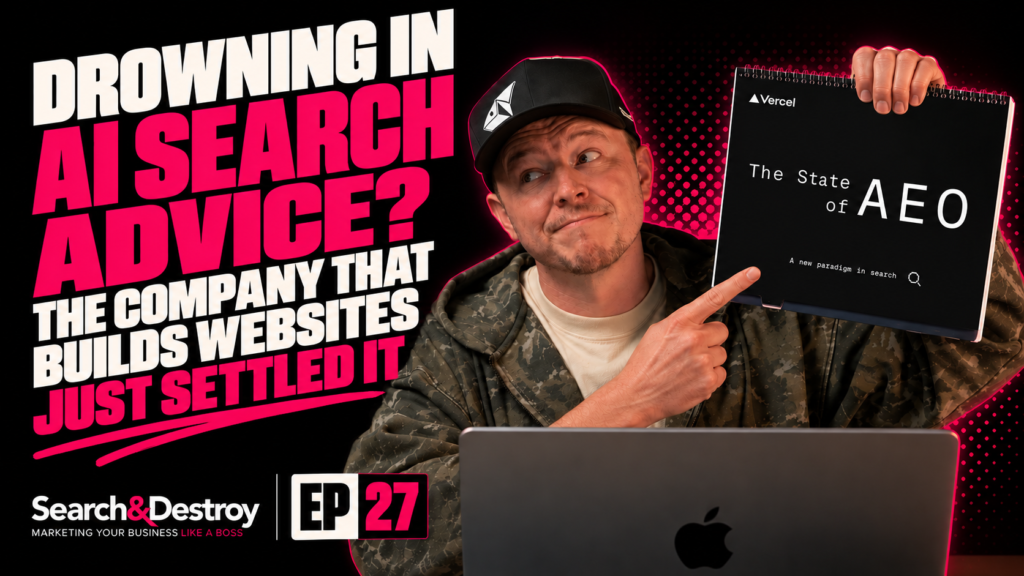
Every week there is a new expert in your feed telling you the exact opposite of what the last one said. SEO is dead, no it is fine, you need AEO, no it is GEO, the click is dead, build a better website, do not even bother with your website. It is a firehose, and half the people shouting are trying to sell you the fix. So this week, instead of one more opinion, I went and got the report the actual engineers put out. Vercel, the company whose technology we build our Smart Sites on, published the definitive breakdown of how AI search works. Most of it confirms exactly what this show has said for months. One part was written for Silicon Valley and could cost a home service business real money if you follow it word for word. Here is the translation.
Why this report is different
The report comes from a company called Vercel. You have probably never heard of them, and there is no reason you would have, because they do not sell to you. They sell to software engineers. Vercel builds the behind-the-scenes technology a huge slice of the modern internet runs on. When a big-name website loads instantly and just works, there is a real chance Vercel’s technology is underneath it.
Think about the difference. Most AI-search advice hitting your inbox comes from a marketing person guessing at how the machine works from the outside, usually while trying to sell you a package. This report comes from the people who actually build the machine. It is the difference between a guy who has watched a lot of car videos and the guy who builds the engine. And I care more than most because Vercel is the company whose technology we build our Smart Sites on. This is the platform under the exact websites we build for home service businesses, telling the world how AI actually reads a site. They put out a report called The State of AEO, answer engine optimization, which is a fancy phrase for a simple idea: how do you become the answer the AI gives, instead of just another link nobody clicks? That is the exact thing we have been hammering on for months, except now the engineers are saying it with the receipts.
What they got dead right
Confirmation one: ranking on Google is not the same as being the answer. The data in the report shows only somewhere between 17 and 38 percent of the pages the AI quotes actually rank in Google’s top ten. Most of the businesses the AI names are not the ones sitting at the top of Google. Picture two companies in your town. One has been number one on Google for years and spent a fortune to get there. The other built their site so a machine can cleanly read exactly what they do and where. A customer asks the AI who to call, and the AI names the second company. That happens now. If somebody is still only selling you “we will get you to number one on Google,” they are playing a game that is half a decade out of date.
Confirmation two: there is no magic button, and nobody can guarantee it. The report says it flat out: no schema markup, no meta tag, no special piece of secret code guarantees you show up in AI search, no matter what any vendor claims. Their words, the engineers. Anybody promising a secret hack, a magic tag, or a proprietary trick is selling something that does not exist, and now the company that actually builds this technology is saying the exact same thing. The next time somebody promises a secret method to lock in the top AI spot, delete it.
Confirmation three: your website’s foundation still matters, a lot. The report is crystal clear that the technical foundation of your site matters enormously. It has to load fast and be built clean underneath so a machine can read it. They get specific: the page has to hand the AI real, readable content, not a jumbled mess that only appears after a bunch of code finishes running in the background. In plain English, if the machine cannot read your site, you are invisible, no matter how good you are at the actual job. If the AI shows up and gets a slow, tangled mess, it moves on to a competitor it can understand, and you never knew you were in the running. A fast, clean, machine-readable site is the price of admission.
Confirmation four: write your content so the AI can lift a clean answer. The way you write matters in a specific way, and most operators have never heard this. The AI does not read your whole page like a person does. It grabs chunks. So the report says to write answer-first: put the clear, direct answer to a customer’s question right up top, in plain language, and keep paragraphs tight and self-contained. If a customer asks the AI a common question about your kind of work, the AI wants to grab a clean three-sentence answer and hand it over. If your site buries that answer in a rambling paragraph, the AI grabs somebody else’s. Answer clearly, right up front, the way a good person would answer at the counter, and you become the easy quote.
The one part written for Silicon Valley, not for you
This report is excellent, but it was not written with your business in mind. It was written for big national tech brands, software companies, and online publishers. And there is one headline that could lead a home service operator badly astray: the report leans hard on the idea that the click is dead, that everything now happens inside the AI answer and nobody visits your website anymore.
For a software company selling to other software companies, there is something to that. Their buyer reads an AI summary, nods, and moves on. But that is not your customer. Picture the real scenario. It is ten o’clock at night, a homeowner’s water heater just let go, water is spreading across the floor, and they grab their phone. That person is not casually reading an AI summary and going back to bed. They are clicking. They are calling. They are booking somebody tonight. For home services, the click is absolutely not dead. The customer with an emergency and a credit card is still the whole ballgame. Here is the honest translation: the click is not dead, but the step right before it, discovery, the moment the customer decides who is even worth calling, is the part AI is reshaping. You still want that call just as badly. What is new is that you now have to be one of the names that survives the AI step in front of it. This is also exactly why I would never tell you to pull back on good paid search. When that homeowner types “emergency plumber near me” at ten at night and your ad is right there, that is a customer at the exact second they are ready to spend. No AI report changes that.
What to do this week
If you take nothing else from the whole report, here are three things you can do this week. One, test whether a machine can even read your site: run it through Google’s free PageSpeed tool, or pull it up on your phone on cell service and count the seconds. Slow and clunky is the first thing to fix, because nothing else matters if the AI cannot read you. Two, fix your most important pages to answer first: take your top few service pages and make sure the clear, plain answer to what a customer actually asks is right at the top, short and direct, no fluff. Three, stop paying anyone selling you a secret: you now know, from the engineers themselves, that no magic tag or guaranteed top AI spot exists, so put that money toward building the thing right.
Frequently asked questions
Does ranking number one on Google get me into AI answers?
Not by itself. Vercel's report shows only roughly 17 to 38 percent of AI-cited pages rank in Google's top ten. Being the clearest, most machine-readable answer matters more than your Google position.
Is there a schema tag or code that guarantees AI visibility?
No. Vercel states plainly that no schema markup or meta tag guarantees you show up in AI search. Any vendor promising a secret hack or magic tag is selling something the engineers who build this technology say does not exist.
Is the click really dead?
Not for home services. That headline was written for national brands and publishers whose buyers read an AI summary and move on. A homeowner with an emergency still clicks, calls, and books. What AI is reshaping is the discovery step right before the click, deciding who is worth calling.
What actually makes a website readable to AI?
Speed and clean construction. The page must hand the AI real, readable content immediately, not a jumbled mess that only appears after background code finishes running. Then write answer-first, with the direct answer to a customer question at the top in plain language.
The bottom line
The engineers just confirmed the four things that matter. Ranking on Google is not the same as being the answer, so stop chasing only that. There is no magic code, so stop paying anybody who swears they have one. Your website has to be fast and clean enough for a machine to read, because if it cannot be read, you do not exist. And you have to write so the AI can lift a clean answer straight off your page. That is not a sales pitch from me. That is the company that builds the technology, saying it in black and white. And the one thing they got wrong for your world, the click is dead, just flip it: for home services the click is alive and well, and your job is to be the name the AI hands the customer right before they make that click. Build the thing right, and show up where your customer is looking.
If you want a website actually built to be read by AI, the exact way that report lays out, that is the entire reason our Smart Sites exist, built on the very platform that wrote the report. If you want that on your side, come talk to us at lizardmarketing.co. We work exclusively with home service businesses.
By Mat Rogers, CEO of Lizard Marketing.
Sources
Vercel, The State of AEO (2026 report), featuring Vercel CTO Malte Ubl; companion strategy post: vercel.com/blog/how-were-adapting-seo-for-llms-and-ai-search. Ranking-versus-citation figures (roughly 17 to 38 percent of AI-cited pages rank in Google’s organic top 10) from BrightEdge and Ahrefs, via the report. Vercel’s own position that no schema markup or meta tag guarantees AI visibility, and its advice to prioritize retrieval and indexability over hype, are from that report and its public strategy post. The “click is dead” framing is noted as written for national brands and publishers, not home services.