It is planning season, and if you are like most home service owners, your entire 2027 marketing budget is about to be decided by a gut feeling. Here is something better: a dead-simple formula built on the revenue you are actually going to do, not a number you pulled out of the air. Project your gross revenue, commit at least 6 percent of it to grow, spend it to lead your season by four to six weeks, and point it at the five tools that actually win next year. Grab a pen. This is a worksheet, not a lecture.
Step 1: find your projected gross revenue
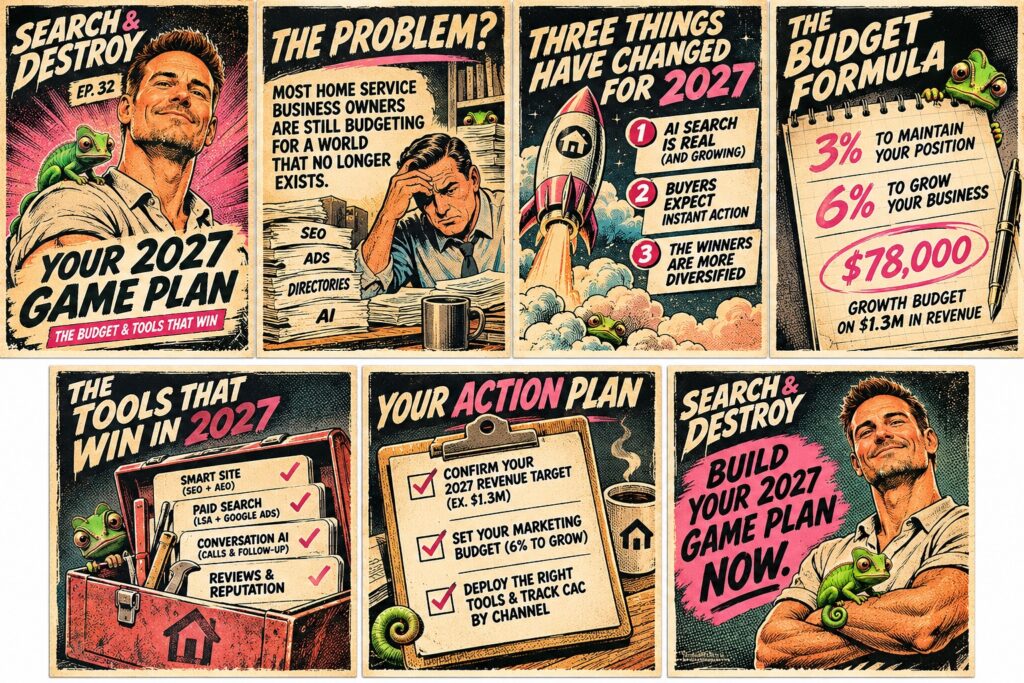
Everything starts with one number, and it is not last year’s revenue. It is your projected gross revenue for 2027. Take what you have actually done so far in 2026, add a realistic estimate for the rest of this year, and that gives you your full 2026 number. Then ask the real question: where do you want to be by the end of 2027? Not a fantasy, a real, reachable growth target. That target is your projected gross revenue, and it is the foundation of everything else. For an easy example the whole way through, say you finish 2026 right around a million dollars and you want to grow at a healthy, consistent clip, so your 2027 target is $1.3 million. That $1.3 million is the number we build your budget on.
Step 2: the 3 and 6 rule
Now the formula, and this is the part to tattoo on your brain. There are two numbers, 3 percent and 6 percent. Three percent of your projected gross revenue is the floor just to maintain, the money it takes to hold your ground and not go backwards. If all you want is to stay exactly where you are, you spend 3 percent. Six percent is the minimum to actually grow at a consistent rate. And I want to be clear about the word minimum. You can spend more than 6 percent, plenty of growing companies do, but you should not go below it if growth is the goal. Six is the floor, not the ceiling.
Back to the example. Six percent of that $1.3 million target is $78,000. That is your 2027 marketing budget. For comparison, the 3 percent to tread water is $39,000. The gap between those two numbers is the difference between a business that grows and one that just shows up again next year the same size. You will hear bigger percentages thrown around, the 10 and 12 percent numbers, but those are built for giant national brands fighting on TV. Six percent is the real-world floor for a home service company that wants to grow without betting the whole farm. Start here, and climb from here.
Step 3: divide it into twelve, the smart way
You have your number, $78,000 for the year in the example. Now how do you spread it across twelve months? Most people get this exactly wrong. They either split it dead even, or worse, spend the most when they are already busy and slash it the second things go quiet. Flip that. The key is that marketing has a delay, but it is shorter than most people think. In my experience it is about four to six weeks from when you turn up the spend to when it shows up as booked jobs. So you do not want to start three months early, that is too soon, your leads land before anybody is ready to buy. You want to lead your season by about four to six weeks. If your phone goes crazy in the summer, you start ramping in mid-to-late spring so the work lands right as demand takes off. You are paddling out just before the wave, not a whole season early, and not after it has already broken.
But here is the part almost nobody gets right, and it is the real secret: it is not just how much you spend, it is what you spend it on, and that mix should flip the moment you cross into your season. In that four-to-six-week run-up, go heavy on branding, about 70 percent branding, 30 percent direct response. Branding is the awareness play, getting your name in front of the whole town. Direct response is the phone-ringer, the ad built to book a job today. Why go branding-heavy before the season starts? Because this is the warm-up. You want the market to already know your name so the second they have a problem, you are the one they think of. A slice still goes to direct response to catch the early birds, but the heavy lifting here is awareness. Then the season hits, and you flip it: now it is about 20 percent branding, 80 percent direct response. The demand is live, people are typing “I need this fixed now” into their phone, so you throw your money at the channels that catch that ready-to-buy customer immediately, your Google paid search, your Local Services Ads, the phone-ringers. Keep a little branding running so you do not disappear, but the whole job now is to grab every hand already raised. Same total money, just timed and aimed a whole lot better.
Where it goes: the 2027 toolkit
The tools that worked five years ago are not the tools that win in 2027. The ground under search has moved all year. Here is the toolkit your 2027 budget needs to fund.
- SEO, the foundation. Showing up when somebody searches for what you do. This is not dead, do not let anybody tell you it is. It is the foundation the whole house sits on. But in 2027 it is the price of admission, not the finish line. You have to have it, and it is no longer enough by itself.
2 and 3. AEO and GEO, getting found inside AI. Answer Engine Optimization and Generative Engine Optimization. Do not let the acronyms scare you, they are two sides of the same coin: getting your business named inside the AI answers when somebody asks ChatGPT or Google’s AI who to call. This is the single biggest shift in how customers find you, and most of your competitors have done absolutely nothing about it. That is your opening. The business that gets cited as the trusted answer, while the other guys are still only thinking about old-school Google, wins the customer before the competition even knows the game changed. In 2027, this stops being optional.
- Smart Sites, a website a machine can actually read. Most sites were built to look pretty to a human. In 2027, an AI has to be able to read your site, cleanly and fast, or you simply do not exist to it. We call ours Smart Sites, built from the ground up to be machine-readable, lightning fast, and clear enough that the AI can understand exactly who you are and hand you to the customer. If the machine cannot read your website, none of the rest of this works. It is the engine under all of it.
- AI-informed paid search, and the coming ads inside AI. Paid search still works, it is still one of the best ways to catch a customer at the exact moment they are ready to buy, and your 2027 budget absolutely should include it. But here is what is new and coming fast: ads are starting to show up inside the AI answers themselves. Google is already doing it, and the other AI platforms are right behind. So part of being ready for 2027 is setting aside a small, smart piece of your budget to test these new placements as they open up. Not bet the farm, this is still early and the numbers are still settling. But be an early mover, learn it while it is cheap, and you will own it while your competitors are still figuring out it exists.
Frequently asked questions
What percent of revenue should I spend on marketing?
Use the 3 and 6 rule on your projected gross revenue. Three percent is the floor just to maintain and hold your ground; 6 percent is the minimum to grow at a consistent rate. Six is a floor, not a ceiling, and the bigger 10 to 12 percent figures are built for national brands, not local home service companies.
Do I budget off last year's revenue or next year's?
Next year's. Build the budget on your projected gross revenue, your real, reachable 2027 target, not last year's number. Add your 2026 actuals plus a realistic estimate for the rest of the year, then set the growth target you will build the budget on.
How far ahead of my busy season should I spend?
About four to six weeks, not months. Marketing converts to booked jobs in roughly four to six weeks, so ramping a full season early means leads land before anyone is ready to buy. Lead the wave by four to six weeks so the work arrives right as demand takes off.
How should I split branding versus direct response?
Flip the mix at the season line. In the four-to-six-week run-up, go about 70 percent branding and 30 percent direct response to warm the market up. Once the season hits, flip to about 20 percent branding and 80 percent direct response to capture the live, ready-to-buy demand.
The bottom line
Your 2027 plan is two moves. One, build the budget: project your revenue, commit at least 6 percent of it to grow, and spend it to get ahead of your season by four to six weeks, flipping your mix from branding-heavy to capture-heavy as demand turns on. Two, point that money at the tools that actually win next year: a solid SEO foundation, getting named inside the AI answers with AEO and GEO, a Smart Site a machine can read, and smart paid search with a little set aside to test the new AI placements. The operators who sit down and actually do this, while their competition wings it one more year, are going to look up at the end of 2027 having eaten everybody’s lunch. A plan beats a gut feeling every single time.
If you want a team that builds every one of those tools and helps you set the budget to fund it, that is exactly what we do all day at lizardmarketing.co. Come talk to us before the new year, so you start January already ahead. We work exclusively with home service businesses.
By Mat Rogers, CEO of Lizard Marketing.
Sources
This is a planning framework drawn from Mat Rogers’ experience growing home service companies, not a third-party study. The 3-and-6 rule (3 percent of projected gross revenue to maintain, 6 percent as the floor to grow) and the worked example ($1.0M in 2026 to a $1.3M 2027 target, $39,000 maintain versus $78,000 growth budget) are illustrative. Seasonality guidance reflects Mat’s own experience: lead the busy season by about four to six weeks, since that is roughly how fast direct response converts to booked jobs, and flip the mix across the season line from about 70 percent branding / 30 percent direct response pre-season to about 20 percent branding / 80 percent direct response in-season. The 2027 toolkit (SEO, AEO, GEO, Smart Sites, AI-informed paid search and emerging ads inside AI answers) reflects the shifts documented across this season of the show.